We earn a commission if you buy through our links, at no extra cost to you.
Best Big Trampoline for a Backyard: Size and Space Guide
Planning a big backyard trampoline? Compare 14 to 17 ft rounds, large squares and rectangles, with clearance, wind anchoring, insurance and placement advice.
At a glance
For a big backyard trampoline, measure the yard first, because the footprint plus the maker's clearance is larger than the mat. Vuly Thunder 2 XXL is the largest round here, Springfree Jumbo Square is a large square, Skywalker 15 ft Round is a classic round, and Acon 16 HD is a rectangle. Anchor it against wind.


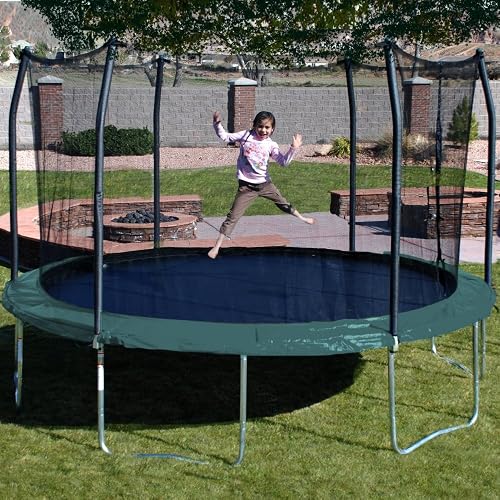
A big trampoline is mostly a yard-planning problem. The mat is the part you see in the photos, but what decides whether it fits is the footprint, the clearance the maker requires around it and the space overhead. This guide covers round, square and rectangular shapes in the 13 to 17 ft class, how to measure and what to settle before you order. To see all eight models we cover, see our best trampolines of 2026 ranking.
We do not run our own product trials. Specs come from maker pages, and safety guidance comes from the CPSC and AAP pages listed under Sources.
Rules to Read First
The Consumer Product Safety Commission (CPSC) says to allow only one person on the trampoline at a time, to avoid somersaults, to use pads that completely cover the springs, hooks and frame, and to place the trampoline away from structures, trees and other play areas. It says no child under 6 should use a full-size trampoline, that a ladder should not be used because it gives small children unsupervised access, and that children should always be supervised.
The American Academy of Pediatrics (AAP) recommends keeping kids of all ages away from trampolines, except in settings with professional coaches and specialized equipment. For families that decide to own one, it lists these conditions: one child at a time, an adult watching, no flips, the net zipped, the ladder down when nobody is bouncing, and a check of pads and net before each session. A larger mat does not change any of this. It gives more room, and more room tends to mean more height and more kids wanting to join in.
Round, Square or Rectangle
Round. The most common shape and the easiest to fit into a clearing. Our rounds range from the 14 ft Jumpzylla and SkyBound to the 15 ft Skywalker and Upper Bounce and the 17.36 ft Vuly XXL (a 14.27 ft mat). A round needs the same clearance in every direction, so it is simple to plan.
Large square. Springfree’s Jumbo Square has a 13 x 13 ft mat with 155 sq ft of jumping area, which is more mat than a 13 ft round would have, because the corners are filled. The cost is a 23 x 23 ft area.
Rectangle. The Acon 16 HD has a 17 x 9.8 ft frame. It needs a long, clear run, but it can sit in a narrow, long yard where a round would not. Springfree’s Large Oval (8 x 13 ft mat, 18 x 23 ft space) takes a similar approach to a long, narrow space. See the Springfree Large Oval profile.
Measure the Real Footprint
Start from the maker’s number, not the diameter in the title.
- Springfree: 23 x 23 ft of space for the 13 ft Jumbo Square, which it says includes 5 ft of clearance on both sides and a requirement you must meet.
- Vuly: 17.36 ft overall for the XXL, with a minimum of 6.6 ft around all sides.
- Jumpzylla: 17 to 19 ft of yard space for its 14 ft model.
- Acon: a 17 x 9.8 ft frame and 130 in height with the enclosure.
- Skywalker: 15 ft wide and 9 ft high overall. The page we read does not state a clearance, so find it in the manual.
Mark the area with stakes and string or a garden hose, then walk the outline. Include the clearance in the marked area, not only the frame.
Overhead, Ground and Neighbors
Look up. Springfree lists a height of 9 ft 4 in, Vuly a total height of 9.45 ft and Skywalker 9 ft, and a jumper rises above the mat. CPSC says to keep the trampoline away from structures and trees, which includes branches, roof edges and wires. Look for fences and play structures at the edges of the clearance too.
The AAP says to install the jumping surface as close to the ground as possible. Choose the flattest part of the yard and follow the manual’s guidance on leveling. Do not guess on a slope: follow the manual’s leveling guidance for your model.
Wind and Anchoring
A large mat and net catch wind. Vuly says strong winds can shift or lift trampolines and that you should always anchor your trampoline correctly and follow the installation instructions. Jumpzylla includes a wind stake kit with four galvanized steel stakes and tension straps, and Acon includes an HD anchor kit with 2 anchors. Check what your model includes, and if it comes without anchors, buy a kit that the maker approves.
If a storm is forecast, check the manual for what the maker advises. Do not leave a large trampoline unsecured because it has never moved.
Homeowners Insurance and HOA Rules
The AAP says to check your homeowner’s insurance for coverage of trampoline-related injuries and notes that many policies will not pay when jumpers get hurt. Our advice is simple: call your insurer and ask, in writing if you can, whether a trampoline is covered, excluded or subject to conditions. If you live in a community with a homeowners association, ask whether it has its own trampoline or fence rules before the delivery truck arrives.
Vuly Thunder 2 XXL (17 ft)
The largest round in our selection: a 14.27 ft mat inside a 17.36 ft footprint, with Vuly's clearance figure published up front. For a big, clear yard.
Vuly lists a 6.27 ft net, a 3.00 ft mat height, a 9.45 ft total height, a 308 lb maximum user weight and an 8+ recommended age. It uses leaf springs and a self-closing entry. Its wind warning is the clearest in the group. The shorter warranty on the net, poles and leaf springs (1 year) is the thing to check. See the Vuly Thunder 2 XXL profile.
Springfree Jumbo Square 13 ft
A large square mat with 155 sq ft of jumping area and no steel coil springs. It needs a clean 23 x 23 ft area.
Springfree lists a 9 ft 4 in height, a 220 lb single-jumper capacity, a 1,500 lb maximum capacity and a 10-year warranty on all parts. The Amazon listing is a bundle with a basketball game and ladder. Springfree states that its space requirement must be met, so the footprint is the first thing to confirm. See the Springfree Jumbo Square profile.
Skywalker 15 ft Round (Classic)
A familiar 15 ft round, 9 ft high overall, with a patented no-gap enclosure according to Skywalker. Get the clearance figure from the manual.
Skywalker lists a galvanized steel frame, a recommended individual user weight limit of 275 lb, a stated 1,100 lb total figure and a 3-year limited frame warranty (1 year on the mat, springs, poles and other materials). The page we read does not give spring count, mat diameter or a clearance, so confirm those in the manual before you mark out the yard. See the Skywalker 15 ft Round profile.
Acon 16 HD Rectangular

A 17 x 9.8 ft rectangle with 140 galvanized springs and an anchor kit, for a long, narrow stretch of yard.
Acon lists a 43 in frame height, 130 in height with the enclosure, a 10-year frame warranty and a 515 lb product weight. Its weight-limit wording is inconsistent between the marketing text and the spec tab, so read the manual. See the Acon 16 HD profile.
A Quick Planning Checklist
- Get the space requirement from the maker and mark it on the lawn.
- Check overhead, fences, trees and play structures within that area.
- Pick the flattest spot and plan for the anchors.
- Call your insurer and check any HOA rules.
- Plan where the ladder lives when nobody is jumping.
Sources
Frequently asked questions
How much space does a 14 to 17 ft trampoline need?
More than the frame. Springfree says its 13 ft Jumbo Square needs a 23 x 23 ft area including 5 ft of clearance on both sides, and Vuly asks for at least 6.6 ft around its 17.36 ft XXL. Jumpzylla lists 17 to 19 ft of yard space for its 14 ft model. Always use the number in the manual.
Is a round or a rectangle better for a backyard?
It depends on the yard. A round is the simplest to place in a square clearing. A rectangle such as the Acon 16 HD (17 x 9.8 ft) suits a longer, narrower area, and Acon describes its rectangular bed as giving a more even bounce. Neither shape changes the one-jumper rule.
Do I need to anchor a trampoline?
Vuly says strong winds can shift or lift trampolines and to always anchor correctly. Jumpzylla includes four galvanized steel stakes with tension straps, and Acon includes an anchor kit with two anchors. Follow the manual for your model.
Where should I put a trampoline in the yard?
CPSC says to place it away from structures, trees and other play areas. The AAP says to install the jumping surface as close to the ground as possible and keep it far from trees, walls and buildings.
Does homeowners insurance cover a trampoline?
The AAP says many homeowner's policies will not pay when jumpers get hurt, and advises checking coverage. Call your insurer, and if you have a homeowners association, ask whether it has rules about trampolines before you order.
Can small kids use a big backyard trampoline?
CPSC says no child under 6 should use a full-size trampoline, and the AAP says kids under 6 should never jump. Size does not change that.