We earn a commission if you buy through our links, at no extra cost to you.
Comparison
Best Trampolines 2026: 8 Models Compared
We compared published specs for 8 backyard trampolines from Springfree, Vuly, Acon, SkyBound and more: springless, coil-spring, round, square and oval.
B By the Best Trampolines editorial team ·Published
At a glance
For a large, level yard, start with the Springfree Jumbo Square 13 ft: springless composite rods, a 155 sq ft mat and a 10-year warranty, according to Springfree. The Vuly Thunder 2 XXL (17 ft) is a larger springless round, and the SkyBound SkyLift 14 ft is a mid-range coil-spring option. One jumper at a time, whatever you choose.
A backyard trampoline is a large, long-term purchase, and the eight models here cover three different designs: springless trampolines that use composite rods or leaf springs, conventional coil-spring rounds, and one rectangle. We ranked them from published maker specifications and from the public safety pages listed under Sources, and we attribute every design and certification claim to the company that makes it. None of it comes from trials of our own.
Before the ranking, one point that matters more than any model choice. The Consumer Product Safety Commission (CPSC) says to allow only one person on a trampoline at a time, not to attempt or allow somersaults because landing on the head or neck can cause paralysis, and that no child under 6 years of age should use a full-size trampoline. CPSC also says to supervise children who use a trampoline. The American Academy of Pediatrics (AAP) says kids under 6 should never jump and recommends that kids of all ages avoid trampolines. If a family decides to own one anyway, the AAP lists rules: one child at a time, a grownup always watching, no flips, the net zipped shut, and the ladder taken down when no one is bouncing. A net, a pad or a springless design does not remove these risks, and nothing in this ranking is a promise that any trampoline will keep a child from getting hurt.
How We Chose
We ranked the models on the questions that decide whether a trampoline fits a yard and a family. Warranty length counts for more than usual here, because the product lives outdoors.
Space and clearance. The mat is not the footprint. Springfree lists 23 x 23 ft of clear area for the 13 ft Jumbo Square and 18 x 23 ft for the Large Oval. Vuly asks for 6.6 ft of clearance on every side of the 17.36 ft XXL. CPSC says to place a trampoline away from structures, trees and other play areas, and the AAP says to install the bouncing surface as close to the ground as possible.
Spring system. Coil springs are the traditional design and need a pad that completely covers the springs, hooks and frame, as CPSC says. Springfree uses composite rods under the mat. Vuly uses what it calls Leafspring technology. SkyBound’s SkyLift and the Jumpzylla keep coil springs but use curved poles to hold the net away from the jumping zone. These are maker design claims, and none of them removes the need for supervision.
Single-jumper limit versus total capacity. These are two different numbers. The single-jumper limit applies to the person on the mat. A total or maximum capacity is a structural figure. We list the single-jumper figure when the maker gives one and say so when it does not.
Enclosure and padding. Every model here has a net. CPSC says enclosures can help prevent injuries from falls off trampolines, which is a statement about falls only. The AAP says to check pads and the net for tears, holes and seams that have come apart before every session.
ASTM F381 and other standards. ASTM F381 is the U.S. standard for consumer trampolines. Springfree lists ASTM F2225 and F381, SkyBound states F963, F381 and F2225, and Jumpzylla states F381-16. Skywalker says its trampoline meets ASTM standards, and Machrus says its trampoline is ASTM certified without a standard number. Vuly’s US page lists EN 71-14 and AS4989 instead. We have not seen any certificate.
Minimum age. Makers disagree with each other and sometimes with CPSC. Vuly lists 8+ and Machrus lists 5+, while SkyBound and Springfree describe their trampolines as suited to children of all ages. We follow CPSC’s under-6 line as the floor.
Anchoring. A large trampoline can move in strong wind. Vuly says to always anchor the trampoline correctly, Acon and Jumpzylla include an anchor kit, and Skywalker sells a kit with wind stakes.
Warranty by part. A warranty headline hides details. Frame, mat, springs, net and pad often carry different terms, and we list them by part.
The ranking puts the larger, premium models first. A budget trampoline can fit a family fine, so each section says who it suits. Each model also carries a price-range badge on our site, relative to these eight trampolines.
Comparison Table
#
Model
Shape and size
Spring system
Single-jumper limit, as the maker states it
Warranty headline
1
Springfree Jumbo Square 13 ft
13 x 13 ft square mat, 155 sq ft
Composite rods, springless
220 lb (1,500 lb maximum for the whole trampoline)
10 years on all parts
2
Vuly Thunder 2 XXL (17 ft)
Round, 14.27 ft mat in a 17.36 ft footprint
Leafspring, springless
308 lb maximum user weight
8 years frame, 4 years mat
3
Acon 16 HD Rectangular (Air 16 Sport HD)
17 x 9.8 ft rectangular frame
140 galvanized coil springs
330 lb certified limit; marketing says no limit
10 years frame, 5 years springs and mat
4
Springfree Large Oval 8 x 13 ft
8 x 13 ft oval mat, 92 sq ft
Composite rods, springless
220 lb (1,500 lb maximum for the whole trampoline)
10 years on all parts
5
SkyBound SkyLift 14 ft
14 ft round
Coil springs, curved fiberglass net rods
265 lb recommended maximum user weight
5 years frame, 1 year springs and mat
6
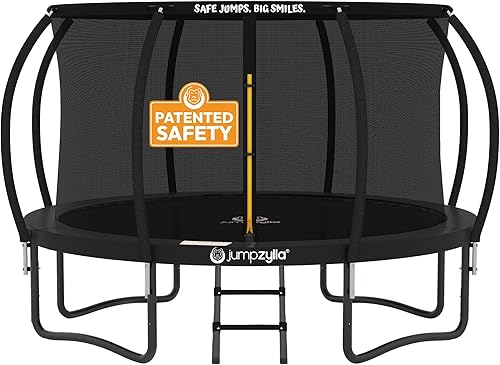
Jumpzylla 14 ft
14 ft round
96 zinc-coated coil springs
Not stated; 450 lb and 375 lb figures
1 year
7
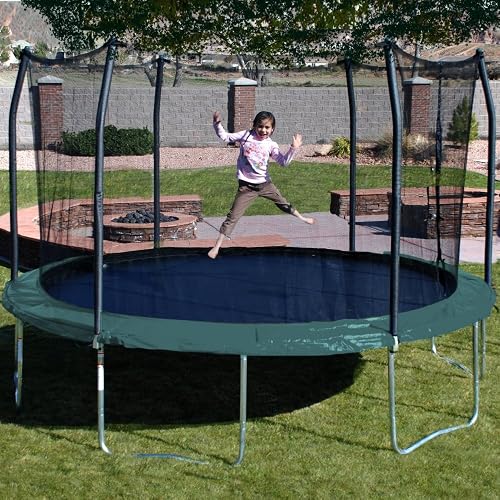
Skywalker 15 ft Round (Classic)
15 ft round
Coil springs
275 lb (1,100 lb total figure)
3 years frame, 1 year other parts
8
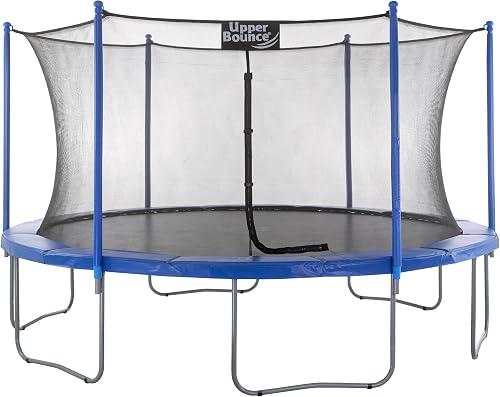
Upper Bounce 15 ft Round
15 ft round
96 coil springs, 7.5 in
Not labeled; 330 lb capacity
6 months on mat, frame and springs
Figures come from the maker pages we opened. Where a page gives two numbers, we show both and say so.
1. Springfree Jumbo Square 13 ft — The Springless Top Pick for a Big Yard
The top pick for a big, level yard and a buyer who wants a long parts warranty and a fixed-frame, springless layout. It does not relax the one-jumper, no-flips rules.
What we like
Springless: Springfree says composite rods sit under the mat and the frame is positioned underneath the jumping surface
13 x 13 ft mat with 155 sq ft of jumping area, according to Springfree
10-year warranty on all parts, with ASTM F2225 and F381 listed by the maker
Drawbacks
Needs a 23 x 23 ft clear area, according to Springfree
Single-jumper capacity is 220 lb, the lowest limit among the large models here
Springfree's pages state no minimum age, so CPSC's under-6 line is yours to apply
According to Springfree, the Jumbo Square uses composite rods under the mat in place of steel coil springs, with the frame positioned underneath the jumping surface. The mat is 13 x 13 ft with 155 sq ft of jumping area, the largest square in Springfree’s lineup. Springfree lists a single-jumper weight capacity of 220 lb and a maximum capacity of 1,500 lb for the whole trampoline, and says the model needs a 23 x 23 ft area. It lists ASTM F2225 and F381 and a 10-year warranty that it says covers all parts.
It ranks first because it combines the largest jumping area of the square and oval models with the longest parts coverage in the group. The trade-offs are the 23 x 23 ft clearance, the premium tier and the lowest single-jumper limit among the large models. The Amazon listing is a bundle with a basketball game and a step. CPSC says not to use a ladder with a trampoline because it gives small children unsupervised access, and the AAP says the ladder comes down when no one is bouncing. Our Springfree Jumbo Square profile has the full specs and FAQ.
2. Vuly Thunder 2 XXL (17 ft) — The Biggest Round, With Leaf Springs
Vuly says the Thunder 2 replaces coil springs with its Leafspring technology, so no traditional spring padding is needed. For the XXL size, Vuly lists an overall diameter of 17.36 ft, a 14.27 ft mat, a net height of 6.27 ft, a mat height of 3.00 ft and a maximum user weight of 308 lb. It lists a recommended age of 8+, 8 years of warranty on frame tubes and joiner poles and 4 years on the jump mat, with 1 year on the net, net poles and leaf springs.
It ranks second because the mat is the biggest here and the age guideline is the most conservative of any maker. Vuly’s US page lists EN 71-14 and AS4989 rather than ASTM F381, so a buyer who wants the U.S. standard should ask Vuly directly. With 6.6 ft of clearance on every side, the clear circle is roughly 30 ft across, which is more than most yards offer. Vuly also says to anchor the trampoline correctly. See the Vuly Thunder 2 XXL profile.
3. Acon 16 HD Rectangular (Air 16 Sport HD) — The Rectangle With a Zipper-Free Net
Acon, a Finnish brand, lists a 17 x 9.8 ft rectangular frame with 140 galvanized 10 in springs, a 43 in frame height and a 130 in height with the enclosure. Its package page lists a SafeMat spring skirt, a zipper-free enclosure entry, a 3-step ladder and an anchor kit with two anchors. The warranty is 10 years on the frame, 5 years on springs and mat, 2 years on hardware and 1 year on the net, and Acon says in-ground installation is not covered.
It ranks third as the only rectangle, with a long frame warranty. Acon’s page is inconsistent on weight: the marketing text says there is no single-user limit, while the spec tab lists a 330 lb ASTM and CE certified limit. We would follow the 330 lb figure and treat the 1,650 lb frame figure as structural, not a count of people. Acon’s marketing also speaks of jumpers of every size and age, which does not match the CPSC and AAP guidance. The Acon 16 HD profile goes through the details.
4. Springfree Large Oval 8 x 13 ft — The Springfree for a Narrow Yard
Springfree lists an 8 x 13 ft jumping mat with 92 sq ft of surface, a footprint of 7 ft 2 in x 13 ft 5 in, a height of 9 ft and a required space of 18 x 23 ft. Like the Jumbo Square, it lists a 220 lb single-jumper capacity, a 1,500 lb maximum for the whole trampoline, ASTM F2225 and F381, and a 10-year warranty on all parts.
It ranks fourth because it gives up about 40 percent of the Jumbo Square’s jumping area for a footprint that fits a side yard. Springfree describes it as suited to kids of all ages, but CPSC’s under-6 line stands and the maker’s pages state no minimum age. The Amazon listing includes a ladder-style step, which the AAP says to take down when no one is bouncing. See the Springfree Large Oval profile.
5. SkyBound SkyLift 14 ft — The Mid-Range Coil-Spring Round With Curved Net Rods
A mid-range coil-spring round with a sensible net design and a 5-year frame warranty. It suits families with children old enough for a full-size trampoline.
What we like
Curved fiberglass rods that SkyBound says hold the net away from the jumping zone, with a zipper at the bottom of the net
265 lb recommended maximum user weight, a one-person figure, per SkyBound
5-year limited warranty on the frame and other parts, according to SkyBound
Drawbacks
SkyBound calls it suitable for children of all ages, which conflicts with CPSC's under-6 line
Springs, net, pad and mat are covered for 1 year
No mat size, spring count or clearance figure on the page we read
SkyBound describes the SkyLift as a coil-spring trampoline with patented curved fiberglass rods that push the net outward, and a zipper at the bottom of the net in place of tie ropes. It lists a recommended maximum user weight of 265 lb and states ASTM F963, F381 and F2225 certification. The frame and other parts carry a 5-year limited warranty, while the springs, net, pad and mat carry 1 year.
It ranks fifth as the first model of the mid-range group: a conventional design with a thoughtful net, at a lower tier than the Springfree and Vuly models. SkyBound gives no mat size, spring count or clearance figure we could cite, and calls the trampoline suitable for children of all ages, which conflicts with CPSC. The 265 lb figure is for one person, not a total. The SkyBound SkyLift profile covers the rest.
6. Jumpzylla 14 ft — The Value Round With an Anchor Kit
Jumpzylla lists curved poles that keep the net away from the jumping zone, a zipped entrance, 96 zinc-coated springs, a galvanized steel frame and a closed-cell foam pad. It states ASTM F381-16 certification and includes a ladder and a wind stake anchor kit. Its size table gives 17-19 ft of yard space and 450 lb for the 14 ft size, while another passage says the joints support jumpers up to 375 lb. The warranty is 1 year.
It ranks sixth because the feature list is good for the tier and the paperwork is not: two weight figures, no clear single-jumper limit and a 1-year warranty. Jumpzylla’s table also lists several jumpers per size. Ignore it, since CPSC and the AAP both say one jumper at a time. See the Jumpzylla 14 ft profile.
7. Skywalker 15 ft Round (Classic) — The Plain, Clearly Labeled Round
Skywalker lists a recommended individual user weight limit of 275 lb and says the trampoline has been ASTM tested to four times that amount, which is where the 1,100 lb figure comes from. That is a total or structural number, not a limit for one jumper. The patented no-gap enclosure (Patent RE45,182) attaches to the mat at every spring, and Skywalker says it meets ASTM standards. The frame has a 3-year limited warranty and other parts 1 year. The size is 9 ft high by 15 ft wide.
It ranks seventh because the design is conventional and the warranty is shorter than the premium models, but the weight wording is the clearest in the group. The page gives no minimum age, and some customer comments on it mention preschool-age children, which CPSC and the AAP advise against. See the Skywalker 15 ft Round profile.
8. Upper Bounce 15 ft Round — The Budget Round With a Full Spec Table
Machrus publishes a spec table: a 159.45 in mat, 96 springs of 7.5 in, six W-legs, eight straight poles, a 34 in frame height and a 108.75 in overall height. It lists a 330 lb weight capacity without saying whether that is per jumper, says the trampoline is ASTM certified, and recommends ages 5 and up. The warranty is 6 months on mats, frame, hardware and springs, and 30 days on pads, nets and foam sleeves.
It ranks last because the warranty is the shortest in the group, which matters for a trampoline that lives outdoors, and because the 5+ age guideline sits below CPSC’s under-6 line. It suits cost-conscious families who read the manual and follow the CPSC rules. See the Upper Bounce 15 ft Round profile.
Most space and the highest age guideline: the Vuly Thunder 2 XXL (17 ft) (#2), if you can give it a clear circle roughly 30 ft across.
A rectangular mat: the Acon 16 HD Rectangular (#3), following its 330 lb certified limit.
A narrow side yard: the Springfree Large Oval 8 x 13 ft (#4), at 18 x 23 ft.
A mid-range round with a 5-year frame warranty: the SkyBound SkyLift 14 ft (#5).
A 14 ft round with an anchor kit: the Jumpzylla 14 ft (#6), read its weight figures closely.
Clear weight labeling in a conventional round: the Skywalker 15 ft Round (#7).
The lowest entry cost: the Upper Bounce 15 ft Round (#8), with its 6-month warranty in mind.
On a tighter budget, look at the coil-spring rounds in positions 5 to 8. Our price-range badges show how the premium Springfree, Vuly and Acon models sit relative to them.
Our Recommendation
For most families with a big, level yard and a premium budget, the Springfree Jumbo Square 13 ft is the pick, with the Vuly Thunder 2 XXL (17 ft) for a yard that can hold a 17 ft round, the Acon 16 HD Rectangular for a rectangle, and the Springfree Large Oval 8 x 13 ft for a narrow yard. Further down, the SkyBound SkyLift 14 ft, the Jumpzylla 14 ft and the Skywalker 15 ft Round are the conventional options, and the Upper Bounce 15 ft Round is the entry point.
Whichever you buy, set it up on level ground, away from trees and buildings, anchor it, check the pads and net before each session, take the ladder down when no one is bouncing, and apply the CPSC and AAP rules above. Check your homeowner’s insurance first, because the AAP notes that many policies will not pay when jumpers get hurt.
How old does a child need to be to use a backyard trampoline?
The Consumer Product Safety Commission says no child under 6 should use a full-size trampoline. The American Academy of Pediatrics goes further: it says kids under 6 should never jump and recommends that kids of all ages avoid trampolines, with rules for families who decide to own one. Makers vary. Vuly lists 8+, Machrus lists 5+, and SkyBound and Springfree describe their trampolines as suited to kids of all ages. We follow the CPSC and AAP line.
Can more than one person jump at a time?
No. CPSC says to allow only one person on the trampoline at a time, and the AAP gives the same rule. Collisions between jumpers are one of the causes of injuries CPSC lists. Some maker pages list several jumpers per size, and we do not follow that advice.
What is the difference between a single-jumper limit and total capacity?
The single-jumper limit is the weight for the person on the mat. Total or maximum capacity is a structural figure. Springfree lists 220 lb for one jumper and 1,500 lb for the whole trampoline, and Skywalker lists 275 lb per user and 1,100 lb as a total. A total figure does not mean several people can jump together.
Are springless trampolines better than coil-spring ones?
They are different designs. Springfree and Vuly say their springless designs remove the exposed springs and the pinch points that come with them. Coil-spring models still rely on a pad over the springs, which you have to keep in good shape. CPSC and the AAP still describe injuries from collisions, bad landings, flips and falls, which do not depend on springs, so no design removes the need for supervision.
How much space does a trampoline need in the yard?
It needs far more than the mat. Springfree lists 23 x 23 ft for the Jumbo Square and 18 x 23 ft for the Large Oval. Vuly asks for 6.6 ft of clearance on every side of the 17.36 ft XXL. CPSC says to place a trampoline away from structures, trees and other play areas, and the AAP says to keep it away from trees, walls and buildings.
Should I check my homeowner's insurance first?
Yes. The AAP says to check your homeowner's insurance for coverage of trampoline-related injuries and notes that many policies will not pay when jumpers get hurt. Some insurers and homeowners associations also restrict trampolines, so ask before you order.