We earn a commission if you buy through our links, at no extra cost to you.
Best Trampoline for Adults and Kids: Family Buyer's Guide
Choosing a backyard trampoline that adults and older kids will both use? Compare weight limits, frames, springs, rods, leaf springs and warranties, plus four models.
At a glance
For a family where adults jump too, compare the single-jumper weight limit, not the total capacity, then the frame and warranty. Acon 16 HD is a heavy-duty rectangle with a 10-year frame warranty, Springfree Jumbo Square is springless, Vuly Thunder 2 XXL lists 308 lb, and Upper Bounce 15 ft is the budget round. One person at a time.


A family trampoline gets used by more than one age group. Kids who are 8 or 10 want it daily, a teenager’s friends show up, and sooner or later an adult wants a turn. That changes what you should check in a product. The main questions are how much weight the maker rates for a single jumper, how strong the frame and joints are, and what the warranty covers. This guide walks through those and then compares four models. For all eight we cover, see our best trampolines of 2026 ranking.
We do not run our own product trials. Specs come from maker pages, and safety guidance comes from the CPSC and AAP pages listed under Sources.
First, the Rules for Everyone
The Consumer Product Safety Commission (CPSC) says to allow only one person on the trampoline at a time and not to attempt or allow somersaults, because landing on the head or neck can cause paralysis. It says to use shock-absorbing pads that completely cover the springs, hooks and frame, to place the trampoline away from structures, trees and other play areas, and to supervise children. It also says no child under 6 should use a full-size trampoline, and not to use a ladder because it gives small children unsupervised access.
That “one person at a time” line applies to adults too. A heavier jumper landing next to a lighter one is exactly the double-bounce situation the American Academy of Pediatrics (AAP) describes, where one jumper lands and sends another into the air. The AAP recommends keeping kids of all ages away from trampolines, except in settings with professional coaches and specialized equipment, and lists conditions for families that own one: an adult always watching, no flips or somersaults, the net zipped shut, the ladder down when nobody is bouncing, the surface close to the ground and a check of pads and net before each session.
So an “adults and kids” trampoline is really a trampoline that adults and kids use in turn. It is not one that four people bounce on together.
Single-Jumper Weight Limit vs. Total Capacity
This is the number most buyers misread. Makers publish two kinds of figures.
The first is the single-jumper (or single-user) limit. Springfree lists 220 lb for its large models, Vuly lists 308 lb for the XL and XXL sizes, and SkyBound lists a recommended maximum user weight of 265 lb. Skywalker says 275 lb for an individual.
The second is a total or structural capacity. Springfree gives 1,500 lb as the maximum for the whole trampoline, and Skywalker’s 1,100 lb is four times its individual figure. Those numbers describe the structure and are not a number of people who can bounce together.
Some pages are less clear. Acon’s page for the 16 HD says one thing in its marketing copy (no single-user weight limit, and 1,650 lb static capacity) and another in the spec tab (a CE and ASTM certified weight limit of 330 lb and a frame that withstands 1,650 lb). Machrus lists a weight capacity of 330 lb for its 15 ft Upper Bounce without calling it per jumper. When a page leaves it open, read the label and manual before buying, or ask the maker. Pick a model whose per-person figure is above the weight of the heaviest person who will actually jump.
Frame, Springs, Rods and Leaf Springs
Frame. Look for galvanized steel and the tube size. Acon says its 16 HD uses galvanized steel with 2.4 in tubes. Jumpzylla says its frame is galvanized inside and out. These are maker claims, not independent measurements, but they show where to look.
Coil springs. SkyBound, Jumpzylla, Acon and Machrus use steel springs. Acon lists 140 galvanized 10 in springs on the 16 HD and Machrus lists 96 springs of 7.5 in on the Upper Bounce. Spring pads should cover the springs completely, per CPSC, and you should check them before use.
Composite rods. Springfree says its trampolines use composite rods under the mat instead of steel springs.
Leaf springs. Vuly says its Leafspring technology takes the place of coil springs.
Springless designs take hardware out of the edge of the jumping area. They do not alter the one-jumper rule, and a springless trampoline does not remove the risk of injury. The AAP lists falling on springs, hooks or the frame as one of several ways kids get hurt, along with collisions and flips.
Shape. A rectangle, like the Acon, gives a bounce that Acon describes as more even and gymnastics-style. A round puts the center at one point. A square spreads the surface into the corners.
Warranty
Warranties differ in length and in which parts they cover. Springfree says it offers a 10-year warranty on all parts. Acon lists 10 years on the frame and 2 on hardware. Vuly lists 8 years on frame tubes and joiner poles, 4 years on the mat, and 1 year on the net, net poles and leaf springs. Machrus lists 6 months on mats, frame parts, hardware and springs, and 30 days on pads, nets and foam sleeves. Since nets, pads and mats take the wear, those shorter terms count more than the headline number.
Acon 16 HD Rectangular
A heavy-duty rectangle with 140 galvanized springs, an enclosure and ladder in the package, and a 10-year frame warranty from Acon. Confirm the weight limit in the manual.
According to Acon, the 16 HD has a 17 x 9.8 ft frame, 140 galvanized 10 in springs, a mat of cross-sewn polypropylene, a spring-covering skirt and a zipper-free double-layer net entry. The package includes a 3-step ladder and an anchor kit with two anchors. The product weighs 515 lb and ships in three packages.
For a mixed family it is the sturdiest build on paper, and the 10-year frame warranty is among the longest here. The weakness is the inconsistent weight wording described above. Remove the ladder when nobody is jumping, as the AAP advises. More in the Acon 16 HD profile.
Springfree Jumbo Square 13 ft
A springless square with a 10-year warranty on all parts, for families whose heaviest jumper is within the 220 lb single-jumper limit.
Springfree says the Jumbo Square has a 13 x 13 ft mat with 155 sq ft of jumping area, a 220 lb single-jumper capacity, a 1,500 lb maximum capacity and ASTM F2225 and F381 listings. It needs 23 x 23 ft of space. The clearly stated single-jumper number and the 10-year warranty on all parts both count in its favor. The 220 lb limit is lower than Vuly’s 308 lb, so check it against your household. See the Springfree Jumbo Square profile.
Vuly Thunder 2 XXL (17 ft)
A large springless round with a stated 308 lb maximum user weight and an 8-year frame warranty. Plan for the big footprint.
Vuly lists a 17.36 ft overall diameter, a 14.27 ft mat, a 6.27 ft net, at least 6.6 ft of clearance and a recommended user age of 8+. Its leaf springs, net and net poles have a 1-year warranty, with an extended warranty available. Vuly also says half-price replacement parts for life are available to buyers from Vuly or an authorized reseller. The weight limit is the highest of the springless group. See the Vuly Thunder 2 XXL profile.
Upper Bounce 15 ft Round
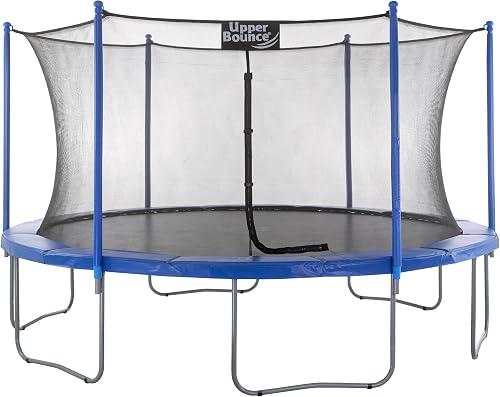
The budget pick of the four: a 15 ft round with 96 springs and a 330 lb capacity from Machrus, held back by a short warranty.
Machrus lists a 159.45 in mat, 96 springs of 7.5 in, six legs, eight straight poles and ASTM certification. It recommends ages 5 and up, but CPSC says no child under 6 should use a full-size trampoline, so treat 6 as the floor. Warranty is its main weakness at 6 months on the mat, frame parts, hardware and springs. It suits a family on a tight budget that accepts that. See the Upper Bounce 15 ft profile.
Which One for Your Household
Start with the heaviest regular jumper and find the single-jumper figure that clears it. After that, compare the warranty on the parts that wear, then the space the maker requires. If adults will use it as much as the kids, the Acon (after confirming the limit in the manual) and the Vuly are the two with the most headroom. If you want the longest warranty, Springfree and Acon lead. If budget is the limit, the Upper Bounce is the entry, and you should plan to replace the net and pad when they show wear.
Whichever you choose, ask your insurer about coverage first, since the AAP says many policies will not pay when jumpers get hurt.
Sources
- CPSC, Trampoline Safety (Publication 085)
- HealthyChildren.org (AAP), Are Trampolines Safe for Kids?
- Acon Air 16 Sport HD package page
- Springfree Jumbo Square product page
- Vuly Thunder 2 product page
- Machrus Upper Bounce 15 ft product page
- SkyBound SkyLift 14ft product page
- Skywalker 15ft Round product page
Frequently asked questions
Can an adult and a child jump on a trampoline at the same time?
No. CPSC says to allow only one person on the trampoline at a time, and the AAP says only one child jumps at a time. The AAP names the double bounce, where one jumper lands and sends another into the air, as a way kids get hurt.
What is the difference between single-jumper limit and total capacity?
The single-jumper limit is the weight the maker rates for one person. Total or maximum capacity is a structural figure. Springfree, for example, lists 220 lb single-jumper and 1,500 lb maximum for the whole trampoline, and Skywalker lists 275 lb and 1,100 lb. The total is not a head count.
Are springless trampolines better for adults?
They are different, not automatically better. Springfree and Vuly say their designs replace steel coil springs with composite rods or leaf springs. That removes springs from the edge, but it does not change the one-jumper rule. Check each maker's single-jumper number.
How long should the warranty be?
Look at which parts the warranty covers and for how long. Springfree lists 10 years on all parts, Acon 10 years on the frame and 2 on hardware, Vuly 8 years on frame tubes and 1 year on the net, and Machrus 6 months on the mat and frame parts.
Should my kids use it if adults are jumping?
Not at the same time. CPSC says no child under 6 should use a full-size trampoline, and the AAP recommends keeping kids of all ages away from home trampolines except in settings with professional coaches. If you own one, an adult should be watching whoever jumps.
Does homeowners insurance cover a trampoline?
Not always. The AAP says many policies will not pay when jumpers get hurt. Ask your insurer before you buy.