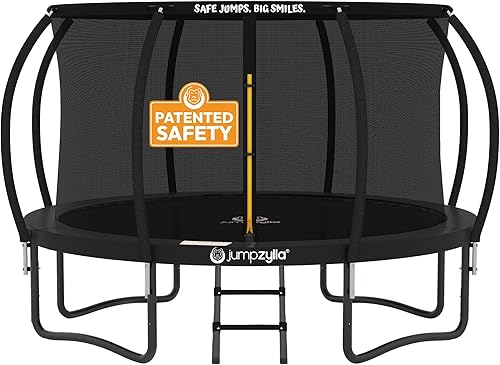
The Jumpzylla 14 ft is a round, coil-spring backyard trampoline sold mostly on value and on a long list of features: curved poles, a zipped entrance with two buckles, a thick spring pad, a ladder and a wind anchor kit. The Amazon listing we link to is the 14 ft in black. In our best trampolines of 2026 ranking it is one of the mid-range options, alongside the SkyBound SkyLift 14 ft, which uses a similar curved-rod idea.
We do not run our own product trials. This profile restates what Jumpzylla publishes, along with guidance from the Consumer Product Safety Commission (CPSC) and the American Academy of Pediatrics (AAP). Where Jumpzylla’s page contradicts that guidance or itself, we say so.
Read This First: Rules That Apply to Every Trampoline
Jumpzylla markets heavily around children, and its product page leans on words like “safe” and “peace of mind.” Those are the maker’s words, not ours, and no trampoline earns them without conditions. Here is what the two main U.S. sources say.
CPSC’s trampoline sheet says:
- No child under 6 years of age should use a full-size trampoline.
- Allow only one person on the trampoline at a time.
- Do not attempt or allow somersaults, because landing on the head or neck can cause paralysis.
- Do not use the trampoline without shock-absorbing pads that completely cover the springs, hooks and frame.
- Place the trampoline away from structures, trees and other play areas.
- Do not use a ladder with the trampoline, because it provides unsupervised access by small children.
- Always supervise children who use a trampoline.
The AAP, on HealthyChildren.org, recommends that kids of all ages avoid trampolines and says kids under 6 should never jump. If a family decides to have one, the AAP asks for one child at a time, no flips or somersaults, the safety net zipped shut during use, the ladder taken down when no one is bouncing, the surface as close to the ground as possible, and a check of pads and net for wear before every session. It also points out that many homeowner’s insurance policies will not pay for trampoline injuries.
One jumper at a time. Jumpzylla’s size table lists several “jumpers” for each size, and for the 14 ft it says 4. We do not repeat that as advice. ASTM F381 warning labels, CPSC and the AAP all say one jumper at a time, and the AAP specifically names the double bounce, where one jumper lands and sends another into the air, as a way kids get hurt. Read the table as a rough indication of how much floor area the mat has, not as a head count.
The Short Version
According to Jumpzylla, the 14 ft model has a galvanized steel frame, 96 zinc-coated springs, a closed-cell foam spring pad, curved poles that keep the net away from the jumping zone, a zip-and-buckle entrance, a ladder and a wind stake anchor kit. Jumpzylla says it is certified to ASTM F381-16. The warranty is 1 year.
It is a feature-rich, mid-range round. Its weak points are an inconsistent set of weight figures on the product page, the multi-jumper table we just discussed and a short warranty.
Key Specs
All figures below are Jumpzylla’s, from its 14 ft product page.
- Size: 14 ft, round. The yard space Jumpzylla lists for this size is 17 to 19 ft across.
- Frame: Galvanized steel, with a reinforced joint system and a four-leg design. Jumpzylla says the frame is 50 percent thicker than standard and galvanized inside and out.
- Springs: 96 zinc-coated springs, which Jumpzylla says are rated for more than one million compressions.
- Mat: Woven, UV-resistant, 8-row stitching, with a UV rating of 5,000 hours, according to Jumpzylla.
- Spring pad: A 25 mm closed-cell foam layer covering the springs, wrapped in weatherproof vinyl.
- Enclosure: A triple-layer system of mesh, UV-resistant PVC coating and inner foam lining; double-stitched at stress points; a zipper entrance with two exterior buckles.
- Poles: Curved, to hold the net outward from the jumping zone. Foam covers the poles and edges.
- Ladder: Included, with wide anti-slip steps.
- Anchoring: A wind stake anchor kit with four galvanized steel stakes and tension straps.
- Standards claimed: ASTM F381-16, plus TUV, ISO 9001:2015 and CPC.
- Assembly time: 60 to 90 minutes according to Jumpzylla.
- Warranty: 1 year. Extended and storm warranties are sold separately.
This is where the product page needs a careful reading. The size table lists the 14 ft as 450 lbs max. Elsewhere, in the section about the frame, Jumpzylla says the reinforced joint system supports jumpers up to 375 lbs. Both are Jumpzylla’s figures, and they do not match.
Neither number is labeled as a per-jumper limit, and a table that pairs “450 lbs max” with “4 jumpers” suggests the first figure is an overall rating, not a limit for one person. We cannot confirm which, and Jumpzylla’s page does not say. A reasonable approach:
- Find the weight figure printed in the manual and on the warning label that ship with the trampoline, because that is the one the maker stands behind for that unit.
- If the label gives a single-user limit, use it.
- If you cannot tell which figure applies, use the lower one, 375 lbs, as the ceiling for one person.
Whichever figure applies, remember that a total capacity is not permission for several people to jump together. A single jumper’s weight and dynamic load on the mat are what matter, and the one-jumper rule applies at any size.
Design: Curved Poles and the Zipped Entrance
Straight enclosure poles leave the net hanging at the edge of the frame. Jumpzylla’s curved poles bend outward so the net sits farther from the jumping area. The company says this keeps kids away from the net and expands the usable jumping area. As a design idea it is sound: a larger gap between a jumper and a hard pole is better than a smaller one. It is also not a guarantee, and it does not address collisions, bad landings or flips.
The entrance uses a heavy-duty zipper with two exterior buckles. Jumpzylla says this prevents accidental opening. The AAP asks that the net stay zipped shut while kids jump, so a closure that is hard to leave half-open is a reasonable feature. Check the zipper and buckles regularly for wear, especially after a winter outside.
Spring Pad and Frame Details
CPSC says never to use a trampoline without pads that completely cover its springs, hooks and frame. Jumpzylla describes a 25 mm closed-cell foam pad that covers all springs, encased in weatherproof vinyl. Closed-cell foam absorbs less water than open-cell foam, which matters for a pad that lives outdoors. Replace a pad that is torn, cracked or no longer sits flat, as the AAP says: check pads and net every time, and replace worn ones before kids go back on.
The frame uses galvanized steel and a four-leg stance. Jumpzylla calls it extra-stable and says the design prevents tipping. We would not rely on that; a trampoline in a gust is a sail. The included anchor kit is more meaningful, and it is one of the better inclusions in this class. Use it, and check the stakes and straps after bad weather.
Space and Placement
Jumpzylla suggests 17 to 19 ft of yard space for the 14 ft size. That is only a few feet beyond the diameter, so treat it as a floor, not a target. Following CPSC, keep the trampoline away from structures, trees and other play areas, and check overhead for branches and wires. Choose level ground and clear the area around the frame. The AAP adds that the bouncing surface should be as close to the ground as possible.
Warranty and Support
Jumpzylla lists a 1-year warranty. It sells extended and storm warranties as add-ons, and says replacement parts ship from a U.S. warehouse with a discount for customers. One year is on the short side for a trampoline that stays outside, and the springs, mat, pad and net are the parts that wear. If you buy, read the terms of the standard warranty and decide whether the add-ons make sense for your climate. We have not evaluated them.
Pros and Cons
Pros
- Curved poles, a zipped entrance with two buckles and a thick spring pad, per Jumpzylla.
- ASTM F381-16 certification claimed by the maker.
- Ladder and wind stake anchor kit included.
- Galvanized steel frame and zinc-coated springs.
Cons
- Two different weight figures and no clearly labeled single-jumper limit on the product page.
- The size table’s multi-jumper counts contradict CPSC and AAP guidance.
- A 1-year standard warranty.
- The page we read does not state a minimum age.
Who It Is For
The Jumpzylla 14 ft suits a household with school-age children who want a mid-range round with a net that sits away from the jumpers and an anchor kit in the box. It fits a yard with about 17 to 19 ft of clear level space and a parent who will enforce one jumper at a time, supervise, and remove the ladder when no adult is watching.
It is a poorer fit for anyone who needs a clearly stated per-person weight limit before buying, or for families with children under 6, who should not use a full-size trampoline at all. If you prefer a classic design with a published single-user limit and a longer frame warranty, look at the Skywalker 15 ft Round, or compare the whole field in our trampoline ranking.
For current availability, see the Jumpzylla 14 ft on Amazon, and confirm the size and color (black) on the listing.
Sources