We earn a commission if you buy through our links, at no extra cost to you.
Best Trampoline for Big Kids Ages 8-12: Buyer's Guide
Shopping for a trampoline for kids 8-12? Mat size, per-jumper weight limits, net height, ladder rules and the CPSC and AAP guidance, plus four models to compare.
At a glance
For kids 8 to 12, look for a 13 to 14 ft mat, a single-jumper weight limit well above your child's size and a tall net. Springfree Jumbo Square has no coil springs, Vuly Thunder 2 XXL has the tallest net, SkyBound SkyLift 14 ft is the mid-range coil-spring pick, and Jumpzylla 14 ft adds a wind anchor kit. One jumper at a time.


Parents searching for a trampoline for 8- to 12-year-olds are usually dealing with a kid who has outgrown the small one. A bigger, more energetic child means a bigger mat, a higher weight rating and more attention to rules. Before the shopping advice, a plain statement of where official guidance stands: the American Academy of Pediatrics (AAP) recommends keeping kids of all ages away from trampolines, except in settings with professional coaches and specialized equipment. It also says that if you decide to let older children jump, certain rules should apply. This guide assumes you have already decided to buy one and want to choose well. For all eight models we cover, see our best trampolines of 2026 ranking.
We do not run our own product trials. Specs come from maker pages, and safety guidance comes from the CPSC and AAP pages listed under Sources.
Rules That Come Before the Model
The Consumer Product Safety Commission (CPSC) trampoline sheet says to allow only one person on the trampoline at a time, to avoid somersaults, to use shock-absorbing pads that completely cover the springs, hooks and frame, and to place the trampoline away from structures, trees and other play areas. It says no child under 6 should use a full-size trampoline, that a ladder should not be used because it gives small children unsupervised access, and that children should always be supervised. It adds that enclosures can help prevent injuries from falls off the trampoline. That sentence is about falls only.
The AAP adds a list for families that own one: one child jumps at a time, a grown-up is always watching, no flips or somersaults, the net stays zipped shut while kids jump, and the ladder comes down when no one is bouncing. If you install a trampoline, it says to put the jumping surface as close to the ground as possible, keep it far from trees, walls and buildings, and check the pads and net for tears, holes or open seams every time before kids jump.
These rules matter more at 10 than at 6. Older kids jump higher, invite friends over and want to try tricks. The AAP names several ways kids get hurt: colliding with others, landing wrong, falling from the surface, the double bounce and risky moves such as flips. None of the products below changes that. Treat the net, pads and springless designs as equipment that helps with certain risks, not as a guarantee.
What Changes at Ages 8 to 12
The mat needs room. A growing child covers more ground and bounces higher. A mat in the 13 to 14 ft range gives a bigger buffer around the center than an 8 or 10 ft model. Bigger mats need more yard, so measure first.
Weight limits start to matter. A per-jumper limit is the figure you should read, and it is not the same as total capacity. Springfree lists a single-jumper capacity of 220 lb and a maximum weight capacity of 1,500 lb for the whole trampoline. Skywalker says something similar: 275 lb for an individual and 1,100 lb as a total figure. The total is not a number of kids who can jump together. Pick a trampoline whose single-user limit still fits the largest person who will ever use it, including friends, older siblings and a parent stepping on to check the mat.
Net height counts. Vuly says its XXL has a 6.27 ft safety net and a 3.00 ft mat height. Taller nets give more wall around a child who bounces higher. A net helps with falls off the side, and it does nothing about landing badly on the mat.
Age labels vary. Vuly lists a recommended user age of 8+. Other makers do not state a minimum age on the pages we read. Whatever the box says, CPSC’s under-6 line applies.
Springfree Jumbo Square 13 ft
A large square mat with no steel coil springs, for families with a roomy, level yard who want a long warranty. The Amazon listing is a bundle that includes a basketball game and a ladder.
According to Springfree, the Jumbo Square has a 13 x 13 ft mat with 155 sq ft of jumping area, composite rods under the mat in place of steel springs, a single-jumper capacity of 220 lb, ASTM F2225 and F381 listings, and a 10-year warranty. It needs a 23 x 23 ft area, which Springfree says includes 5 ft of clearance on both sides.
For this age group the appeal is the square mat, which spreads the jumping surface into the corners, and the lack of exposed coil springs. Springfree’s design removes the springs from the edge, which addresses one item on CPSC’s list of injury causes (falling on the springs or frame). It does not address collisions or flips. The 220 lb single-jumper limit is the lowest in this guide (SkyBound’s 265 lb is next), so a family with teenagers or adults using it should read that figure carefully. The Amazon listing includes a ladder, so follow the AAP advice to remove it when nobody is bouncing. More in the Springfree Jumbo Square profile.
Vuly Thunder 2 XXL (17 ft)
The roomiest model here, with a 14.27 ft mat, a 6.27 ft net and a recommended age of 8+ from Vuly. Needs the biggest yard.
Vuly lists the XXL at 17.36 ft overall with a 14.27 ft mat, a 6.27 ft net, a 9.45 ft total height and a maximum user weight of 308 lb (330 lb for the L size). It asks for at least 6.6 ft of clearance on all sides, and it uses leaf springs instead of coils. The entry is self-closing.
Of the four, it is the one most clearly aimed at kids in this range, because the maker states an 8+ recommended age and the net is the tallest of the group. Two caveats. First, the footprint plus clearance is large, so check your yard before anything else. Second, the net, net poles and leaf springs carry a 1-year warranty, shorter than the frame and mat. Vuly also says strong winds can shift or lift trampolines and that you should always anchor correctly. See the Vuly Thunder 2 XXL profile.
SkyBound SkyLift 14 ft
A mid-range coil-spring round with curved fiberglass rods and a zippered net bottom. A fit for one or two kids who have outgrown a smaller trampoline.
SkyBound says the SkyLift has patented curved fiberglass rods that push the net outward, a zipper at the bottom of the net instead of tie ropes, a recommended maximum user weight of 265 lb and listings to ASTM F963, F381 and F2225. A ladder is included. SkyBound’s warranty summary gives the frame 5 years and the springs, net, pad and mat 1 year.
The curved rods leave more usable mat near the edge, which a 10-year-old will notice. The page we read does not give the mat diameter or the clearance SkyBound recommends, so get the manual figures before choosing a spot. Because this is a coil-spring trampoline, the pad over the springs matters. Inspect it before each use, as the AAP advises. See the SkyBound SkyLift 14 ft profile.
Jumpzylla 14 ft
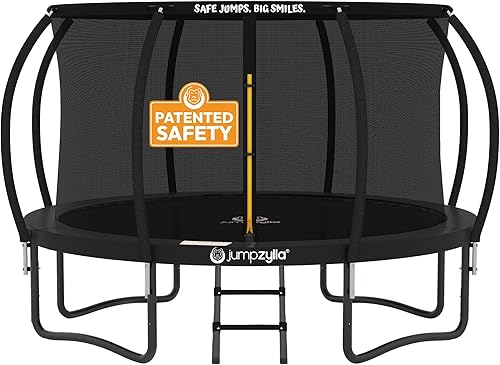
A value-minded 14 ft round with a wind stake anchor kit and a ladder in the box. Read its weight figures and ignore its multi-jumper table.
Jumpzylla says the 14 ft has a galvanized steel frame, 96 zinc-coated springs, a closed-cell foam pad, curved poles that keep the net away from the jumping zone, a zip-and-buckle entrance and certification to ASTM F381-16. It lists 17 to 19 ft of yard space and a 1-year warranty.
Two things need care. Jumpzylla’s page gives 450 lb in its size table and says elsewhere that the joints support jumpers up to 375 lb, so neither is a clean per-jumper limit. And its table lists a number of “jumpers” for the 14 ft. Do not use it as a guide: CPSC and the AAP both say one jumper at a time. The anchor kit is a plus, since wind is a real concern for any large trampoline. Details in the Jumpzylla 14 ft profile.
How to Choose Between Them
Start with your yard and the maker’s clearance number, then the single-jumper weight limit, then the net, then the warranty. If your yard is roomy and you want a springless design, the Springfree is the premium square. If you have the most space and want a model with a stated 8+ age and a tall net, the Vuly fits. If you want coil springs at a more modest range, SkyBound and Jumpzylla are the two to compare, with SkyBound offering the longer frame warranty and Jumpzylla including the anchor kit.
Setting Rules at Home
Write the rules down and post them where kids see them. One jumper. No flips. Net zipped. Ladder off. An adult outside. The AAP also recommends checking pads and net before every session and replacing worn parts before kids get back on. A two-minute check of the net and pad is an easy habit to build into the routine.
Finally, ask your insurer about coverage before you buy. The AAP says many policies will not pay when jumpers get hurt, and that is a question to settle in advance.
Sources
Frequently asked questions
What size trampoline should a 10-year-old have?
There is no official size by age. A 13 to 14 ft mat gives an older child room to land away from the edge, and the real limits are your yard and the maker's clearance figure. Springfree asks for a 23 x 23 ft area for its 13 ft square, and Vuly asks for at least 6.6 ft around its XXL.
Can two kids jump together on a big trampoline?
No. CPSC says to allow only one person on the trampoline at a time, and the AAP lists one child jumping at a time among its conditions. It names the double bounce, where one jumper lands and sends another into the air, as a way kids get hurt.
Are flips okay for older kids?
CPSC says not to attempt or allow somersaults because landing on the head or neck can cause paralysis. The AAP says flips and somersaults cause the most serious neck, head and back injuries. Stick to plain jumping.
Should the ladder stay on the trampoline?
CPSC says not to use a ladder with the trampoline because it gives small children unsupervised access. The AAP says to take the ladder down when no one is bouncing. Most kits include one, so remove it between sessions.
Is my child old enough for a full-size trampoline at 6 or 7?
CPSC says no child under 6 should use a full-size trampoline, and the AAP says kids under 6 should never jump. Age 6 is a minimum, not an endorsement: the AAP still recommends keeping kids of all ages away from home trampolines.
Does homeowners insurance cover a trampoline?
Not always. The AAP says many policies will not pay when jumpers get hurt. Call your insurer before you buy and ask about coverage and any conditions.